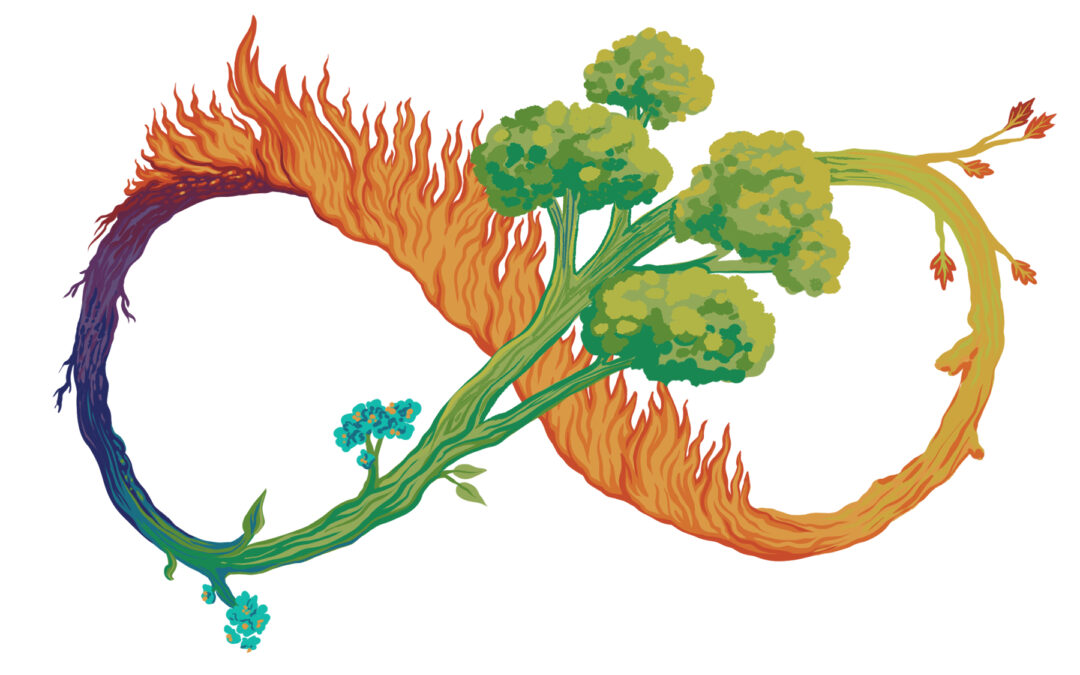
When you first look at the Adaptive Cycle you see an infinity symbol (a lemniscate). This is deliberate because it demonstrates the cyclical nature of an ecosystem. It shows two phases to this cycle, the Growth Phase represented by the traditional s-curve, and the Adaptive Phase. The lemniscate helps us understand that these two phases are connected and that there are limits to growth.
Embedded within each of these two phases, there are also two phases. The Growth Phase is represented by Exploitation and Conservation/Maturity. Remember, when a forest is disturbed the potential for each species to grow is equal. However, some species of plants, animals and other creatures may thrive in the new ecosystem and grow at a faster rate than others. They exploit the environment, and take advantage of the available resources and crowd out other competitors. Over time these larger species have a limited ability to grow and they conserve their energy to preserve themselves. Until something comes along.
Some say the American Chestnut tree made up as much as 50% of the Appalachian forests. It was valued for its rapid growth, rot-resistant wood, and abundant nut production. It was a stable tree in the forest. However, in 1904 the Chestnut Blight, a fungus, rapidly spread across the Eastern forests and eliminated the American Chestnut from the canopy by 1940. In its place oaks, hickories, and maples have taken over the niche held by the American Chestnut. Ultimately the forest changed, new species made up the canopy, while people and animals had to adapt to losing a reliable wood and food source. This is the Adaptive Phase, that time where the two phases of Release and Reorganization take place.
Generally speaking we are more familiar with the Growth Phase (s-curve). From a psychological point of view we are wired to avoid loss and feel more pain from setbacks than joy from gains. We shy away from the potential in creative destruction (some forests and grasslands need controlled burns to preserve the diversity and ecosystem survival). Our ingrained optimism also nudges us to focus on potential success, often overlooking the need for adaptation and resilience in the face of inevitable challenges. Coupled with society’s emphasis on growth and our inherent fear of failure, this creates an environment where the benefits from that phase are undersold.
From a practical business perspective, the s-curve is a widely understood model. As a result, organizations’ tendency lean towards revenue generation at the expense of adaptation. This isn’t to say there has to be failure to implement an adaptive phase, but an organization might not prioritize the need for evolution, until failure emerges. However, when we begin to understand the interrelationship of all four phases along the Adaptive Cycle, we can adapt to changes that occur in the environment around us.
The Adaptive Cycle can be applied to human service organizations. Over my 35 years in the nonprofit human service sector, I have seen organizations come and go. I have seen programs grow, change and adapt. Organizations have lost critical funding that have required them to downsize or even close. See examples of our work in our Portfolio.