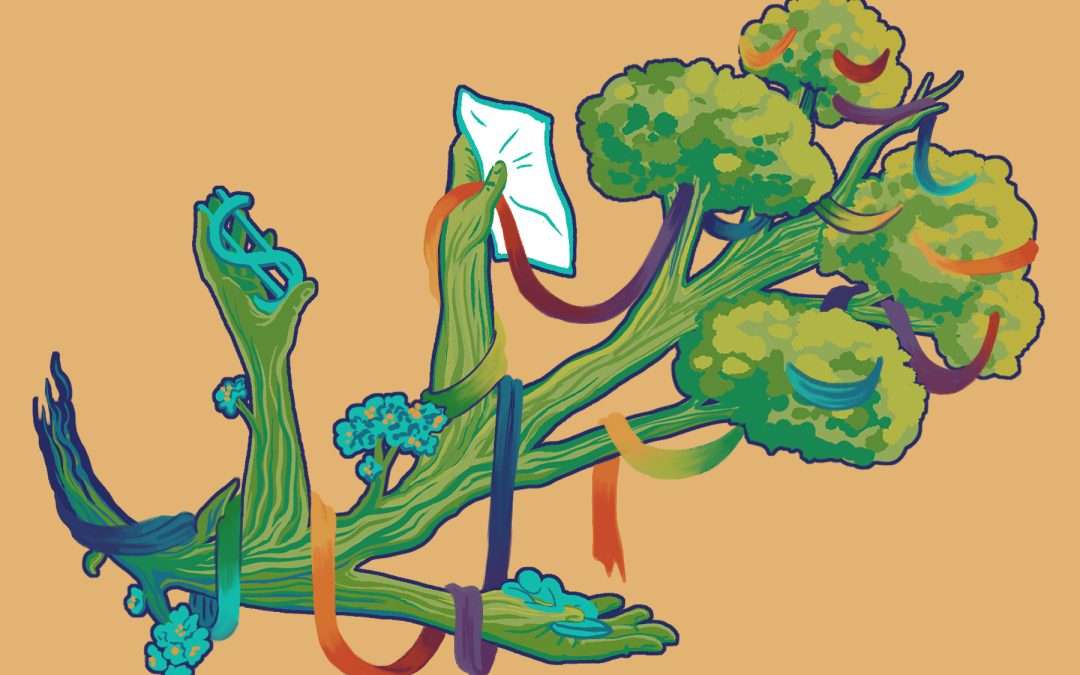
Thirty five years ago, I started my career in nonprofits. During that time I’ve seen nonprofit organizations come and go. I’ve seen passionate people who see a need for services, oftentimes for a loved one, and say, “I want to start a nonprofit.” It is this passion that grows into a valued community resource. It also exemplifies the “front loop” of the Adaptive Cycle.
The Adaptive Cycle has two phases. The Growth Phase is the traditional S-curve that I learned about in my Masters Program studying Health Policy and Administration. It’s that curve that starts at the bottom left, remains flat as it moves toward the left, then slowly arcs up and around to ultimately plateau. It makes up the “front loop” of the Adaptive Cycle and it has two phases itself; Exploitation and Conservation/Maturity.
In the very early years of the AIDS epidemic, many gay men didn’t know what was happening to their friends. They just knew that they were getting sick and dying. They experienced a health care system that was afraid and discriminated against gay men with AIDS. Some men, and women, banded together and started supporting each other and their friends as best as they could.
Eventually, small nonprofits started popping up across the country, enabling people to volunteer, receive services, and ask for tax deductible donations. At the time, all they could do was support those who were falling ill and dying. But they became organized. They found ways to create a system of support as the system around them was failing them. Volunteers delivered food, sat with those who were ill, drove them to appointments, and provided comfort to surviving partners. As the human immunodeficiency virus was discovered and the methods of transmission were understood, organizations created prevention programs.
Seeking support? Contact us about our consulting services.
Outreach and prevention specialists tried all sorts of creative ways to engage men who were having sex with men in improving their condom use. Small house parties modeled after Tupperware parties gathered groups of friends to talk about sex, condoms and ways to keep each other safe. The parties were fun and serious at the same time. They were sex positive and created opportunities for men to talk about their HIV status and practice negotiating condom use with their sex partners. Outreach workers frequented gay businesses, bars and nightclubs displaying free condoms. Innovation was the norm, it was important to try anything to keep our friends from losing their lives.
As these early prevention programs began to show some success. Local and state governments, along with the federal government, began providing funding to scale these programs. The nonprofit AIDS Services Organizations began to grow. As testing became more available, some ASO’s served as testing sites for those at-risk. Organizations and individuals were exploiting all the resources they had available to them to try anything that would work.
ASO’s grew. They became more institutional. They provided a growing stability within the community. Some began providing direct health care services. Advocacy efforts enabled organizations to leverage resources to support the growing number of people living with AIDS. In large urban epicenters of the epidemic, organizations grew and built human resource departments. The creation of dedicated fundraising/finance departments allowed ASOs to manage grant funding more effectively, ensuring compliance and maximizing the impact of every dollar. Information technology departments improved organizational communication via email and implemented electronic tracking mechanisms for organizations to track their work.
While ASOs achieved remarkable success during the Growth Phase, they also faced new challenges as the AIDS epidemic evolved and new treatments emerged. In the next blog post, we’ll explore how these organizations adapted to these changes and navigated the ‘back loop’ of the Adaptive Cycle.